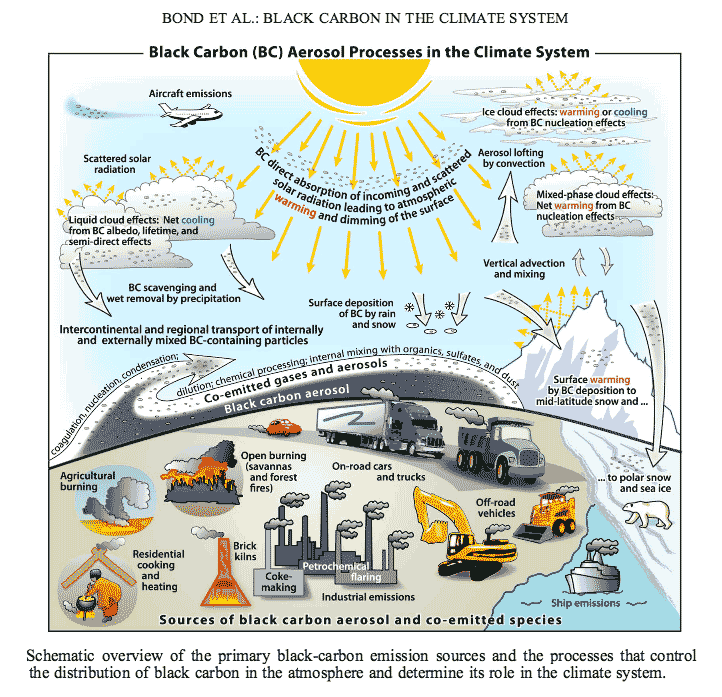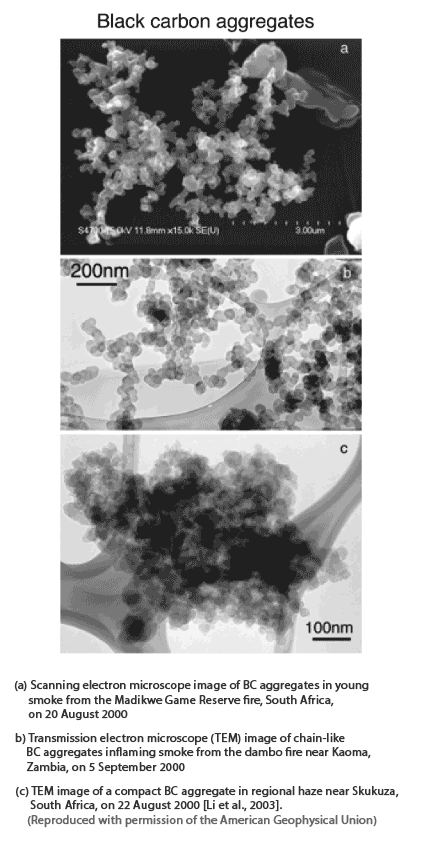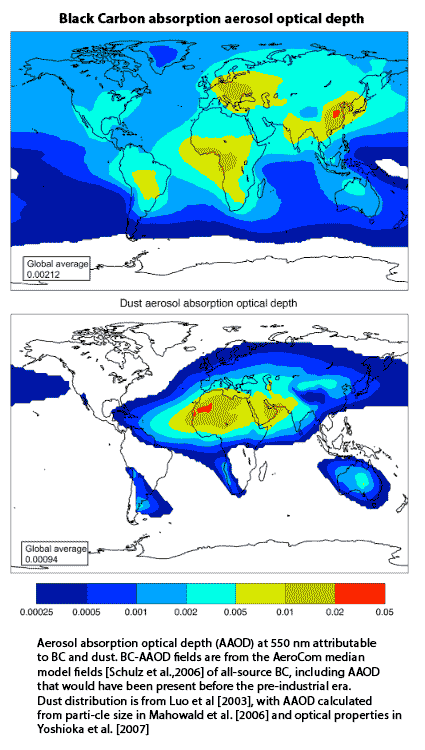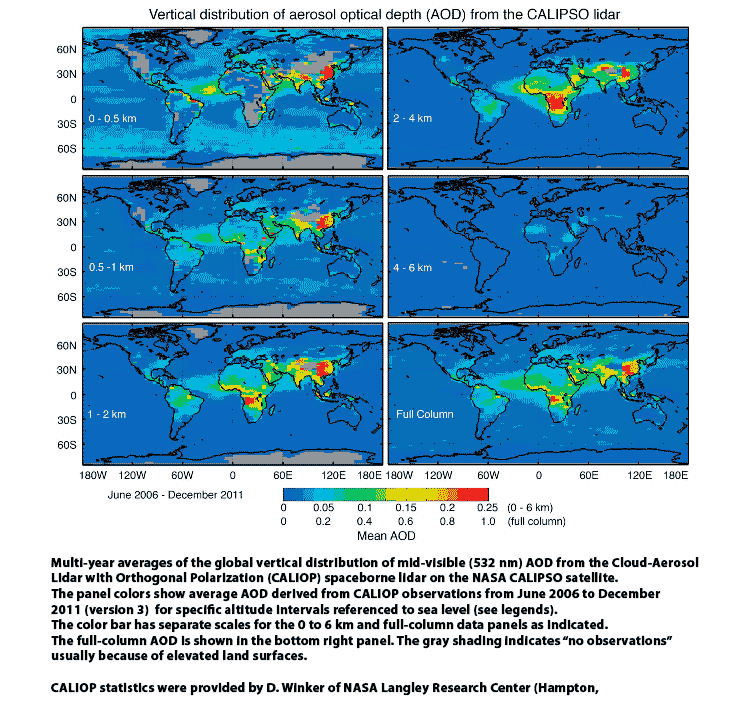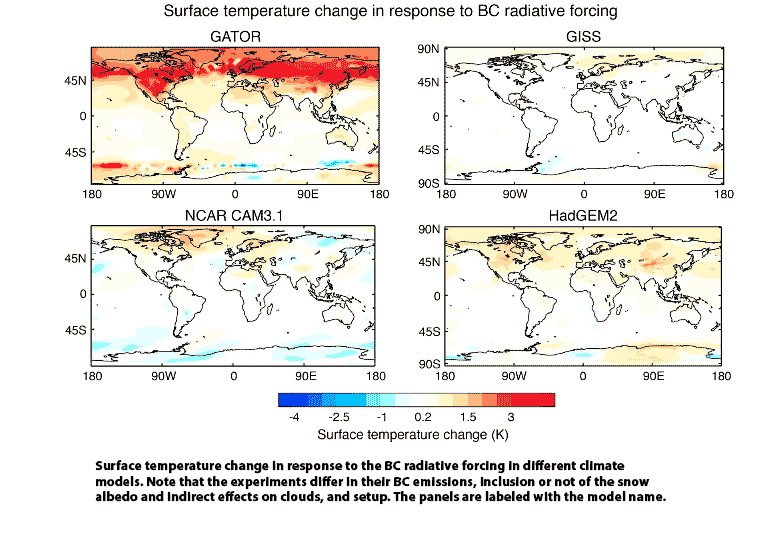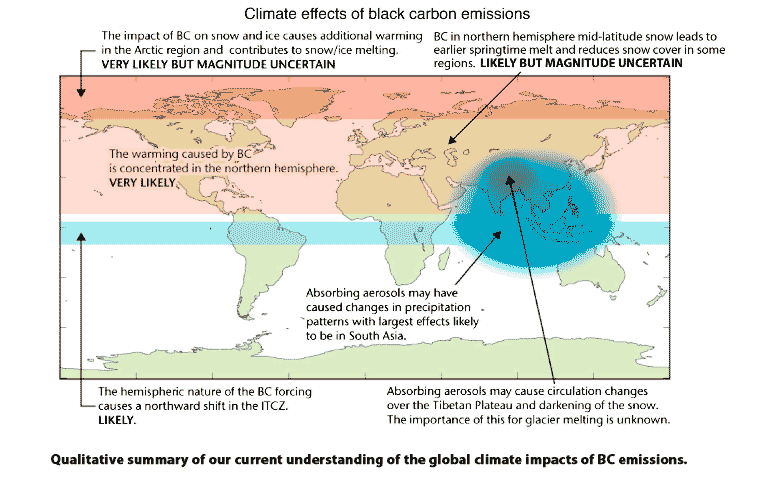
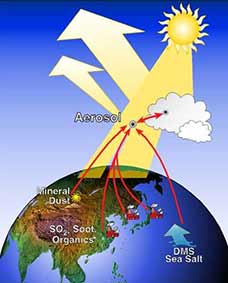
Particulate matter (aerosols) are microscopic particles of solids and/or liquids that are suspended in the atmosphere. There are many natural sources of atmospheric particulates:
dust blown into the air by the wind, salts splashed into the air by sea spray, and soot from volcanoes and forest fires. It seems human-caused soot or black carbon aerosol (BC) air
pollution plays a unique and important role in Earth’s climate system. Black carbon aerosol in the atmosphere deriving from combustion sources such as biomass burning, industrial and
vehicle emissions have the potential to change the temperature profile in the atmosphere and the radiative balance of the earth/atmosphere system. BC in clouds particles will also affect quantities
of energy absorbed by the cloud, so influencing temperature and cloud lifetime. BC or also called soot particles deposited to ice surfaces – glaciers or polar ice sheets – will affect
quantities of energy absorbed by these surfaces, and hence melting rates. It is also thought that BC particles may act as ice nuclei in clouds.
A 4-year, assessment by Bond et al. of (BC) air
pollution's role in climate finds that the combustion product could be warming the world twice as much as previously thought.
See also "Excerts section below".
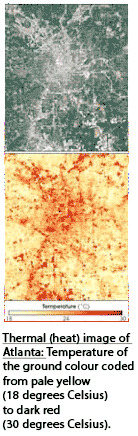
Cities change the weather in their immediate surroundings simply by existing. An urban heat island (UHI) is a metropolitan area which is significantly warmer than its surrounding
rural areas. The phenomenon was first investigated and described by Luke Howard FRS in the 1810s.
The temperature difference usually is larger at night than during the day, and is most apparent when winds are weak. Seasonally, UHI is seen during both summer and winter. The main
cause of the urban heat island is modification of the land surface by urban development which uses materials which effectively retain heat; waste heat generated by energy usage is
a secondary contributor.
The effects of the urban heat island is often overstated. One study stated, there could be no statistically significant impact of urbanisation found in annual temperatures. It was
demonstrated by satellite-based night-light detection of urban areas, and more thorough homogenisation of the time series.
Much of the temperature increase seen in land based thermometers could be due to an increase in urbanisation and the siting of measurement stations in urban areas. For example,
Ross McKitrick and Patrick J. Michaels conducted a statistical study of surface-temperature data regressed against socio-economic indicators, and concluded that about half of the
observed warming trend (for 1979-2002) could be accounted for by the residual UHI effects in the corrected temperature data set they studied -- which had already been processed to
remove the (modeled) UHI contribution.
Critics, including Gavin A. Schmidt, have said the results can be explained away as an artefact of spatial autocorrelation. McKitrick & Nicolas Nierenberg have submitted a rebuttal
defending their results. It should be clearly stated, of course, that we should do everything possible to protect our environment and thus ourselves from harmful effects deriving from
atmospheric particulates (aerosols) due to industrialisation, burning , volcanic action, dust etc. We should try harder to exploit all available technical and financial resources to
reduce or prevent all together the high smog levels in many cities and the burn off of vast agricultural areas predominantly in South East Asia. This is the real threat to mankind and
the real problem accompanied with modern industrialisation. Provided the necessary financial arrangements were made by industry and politicians, nowadays it would be technically possible to reduce the air pollution significantly. It beggars belief why so many governments did not take the steps necessary to reduce emissions of nitrogen dioxide, tropospheric ozone, volatile organic compounds (VOCs), peroxyacyl-nitrates (PAN), aldehydes (R'O), sulphur dioxide, carbon monoxide and heavy metals, etc. Such compounds pollute since decades the atmosphere.
The recent rapid economic growth in China, India and other Southeast Asian countries has been a major factor for a further increase of pollution . Only in Europe the implementation of
modern air monitoring systems and introduction of air purification technologies on a large industrial scale made it possible to reduce air pollution significantly.