The Cosmic Force
Based on recent (last decade), reputable research it became widely accepted that cosmic radiation seems to be the major "driving force" of the climate on earth.
Not later than in 2003 the Israeli astrophysicists Professor Dr. Nir J. Shaviv (Hebrew University, Jerusalem) and the German geologist Professor Dr. Jan Veizer
established the thesis that cosmic radiation (cosmic ray flux, CRF) could be the "motor" of the global warming and cooling periods on our planet.
The impact of cosmic radiation on the terrestrial atmosphere influences pattern, intensity and distribution of cloud formation and consequently the water circulation on earth. The researchers compared the climatic data of the last 600 million years with the intensity of the cosmic radiation at that time and found a correlating periodicity. Two thirds of the variations in temperature on earth are explicable by cosmic radiation. The climate on earth is affected by many different factors, most of them interrelate with each other in form of hierarchic cycles. These interdependent cycles vary in complexity and can be visible or invisible.
Past climatic models considered only the small cycles,
without considering the more complex ones. Veizer's and Shahiv's research did not attempt to consider static background data for terrestrial cycles, it was rather their aim
to look back at 4.5 billion years to the beginning of our solar system. Hence the research of the earth climate and the composition of the atmosphere was undertaken
on the basis of sediments such as coal, salts, fossils and so-called "drop stones". These are stones, which were enclosed in icebergs shifting in "cooling global periods"
in direction of the equator and "dropped' to the ground as soon as the ice melted. One can therefore conclude that the closer to the equator these stones were found the
colder the climate must have been. The result of these studies allowed better understanding of the fact that the climate on earth warmed up in a rhythmic cycle
of approx. 140 million years with cooling periods thereafter.
There must have been a predominant 'climatic engine' on earth because the sun at the beginning of its life was around approx. 30% colder than it is today and approx. 1 billion years
ago the earth should have been deep-frozen as a consequence of that. Traces of live and water existed however for the last approximately 4 billion years.
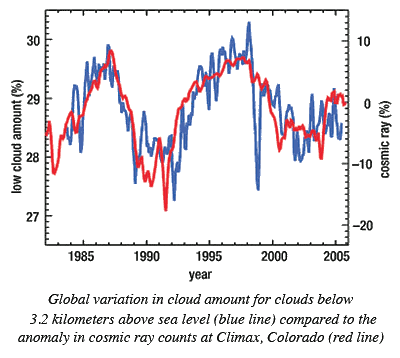
If CO2 would have taken the role of that climate regulator, the CO2 content in the atmosphere should have been approx. 1,000 - 10.000-times higher than today. Such increased level of CO2 was however not detectable in the sediments. If the greenhouse gases CO2 and methane couldn't be made responsible for the temperature increase, the only remaining parameter was at that time as well as it is at present the most important greenhouse gas of all - namely water vapour. There were possibly fewer clouds, the solar heat could reach the earth's surface unhindered. Some models even showed that clouds are quite able to neutralise up to 50 per cent of the sun's radiation fluctuations. Impurities in the gas seem to play a major role during the germination stage. This causality is well correlating with the results of satellite observations of the last years. Clouds act as a shield against solar heat by reflecting the thermal energy back in the universe - the so called cloud albedo. The albedo of an object is the extent to which it diffusely reflects light from light sources like the sun. It is a more specific form of the term reflectivity. To turn the argument means less cosmic radiation leads to fewer cloud formation and consequently the sun can warm the earth up.
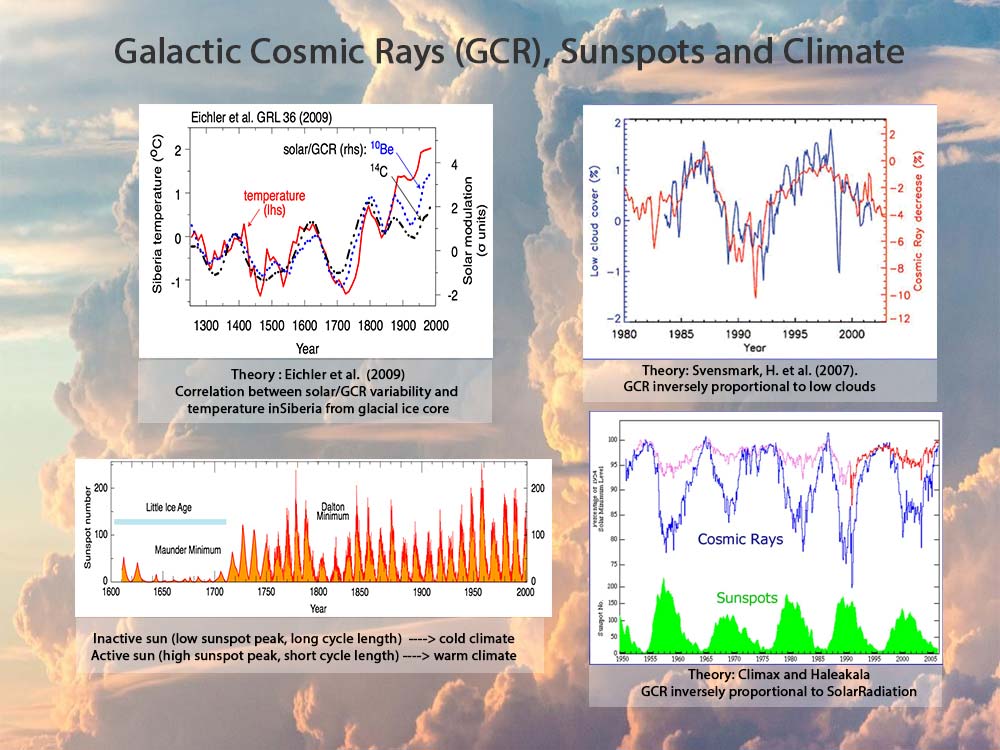
The contact with the astrophysicist Professor Nir J. Shaviv brought Veizer on a new track. Shaviv had examined the impact of cosmic radiation on earth for the last 600 millions years and had determined its heavily cyclical nature, which correlated with that of the earth climate. It was necessary to find more out about the interrelation between cosmic rays and the water circulation. They learned of experiments in gas chambers, which showed that radiation particles colliding with the gas molecules produced the so-called condensation germs, which lead to the vapour condensation and thus to the cloud formation in the gas. The sun itself goes through life cycles and generates for instance periodically more or less sunspots, which go along with increased activity of the sun. These fluctuations do not have enough energy potential necessary on it's own to explain the terrestrial climatic fluctuations. Only the fact that with increased solar activity also the magnetic field of the sun intensifies and more cosmic radiation is deflected away from the earth demonstrates evidence of the causal chain structure. The less cosmic particles hit the atmosphere, the fewer clouds are formed and the warmer the earth becomes!
The science described here shows that CO2 is riding 'piggyback' on the water circulation, because the photosynthesis process requires that plants exhale nearly
1,000 water molecules in order to absorb only one single CO2-molecule. If it is getting warmer, the terrestrial water circulation accelerates,
the bio-productivity increases and the organisms in the ground exhale more CO2. Ice drillings showed that in phases of global heating the CO2-concentration indicated an
upswing only 800 years after the temperature rose.
At best the role of CO2 could be that of a greenhouse-strengthening factor.
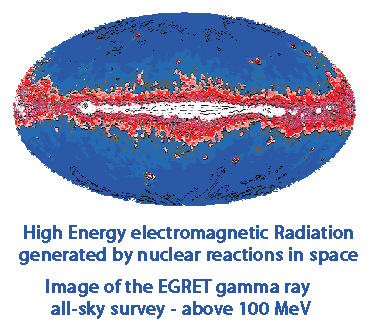
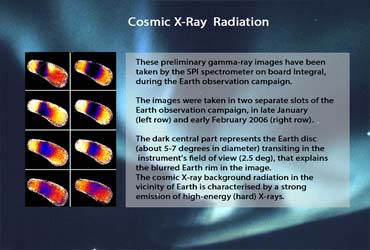 Cosmic rays: Particles from outer space
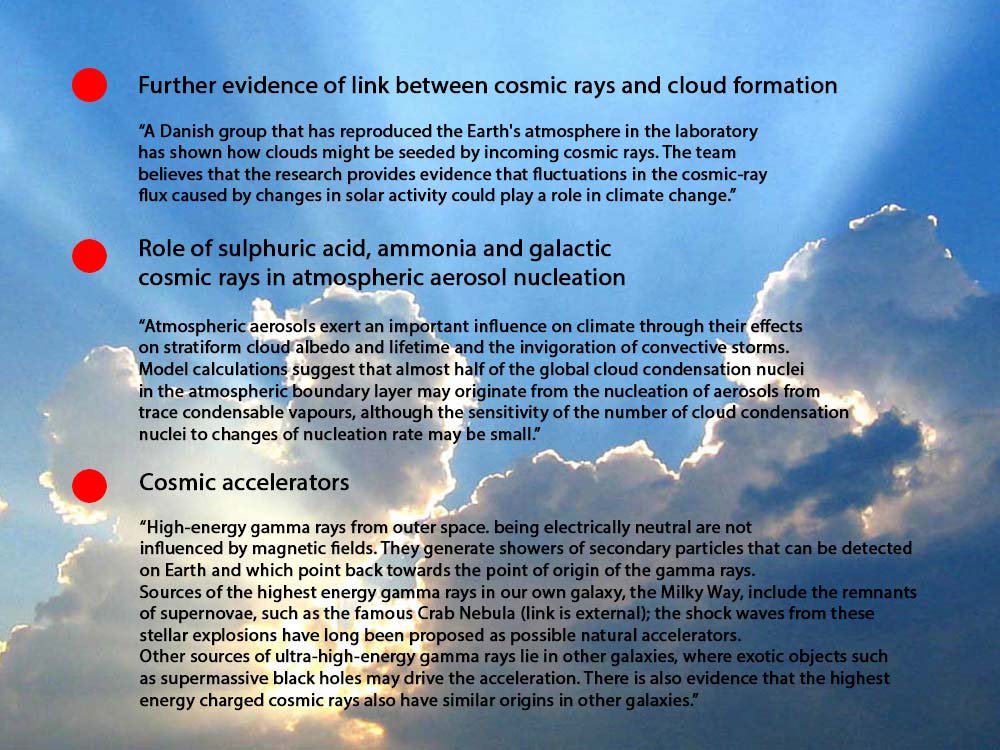
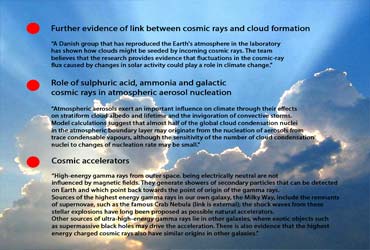 Link between cosmic rays and cloud formation
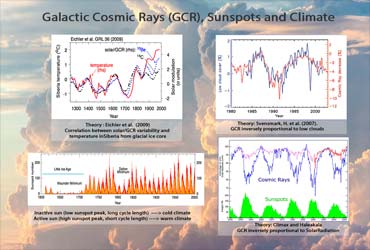 Link between cosmic rays and cloud formation