Today's solutions might again become tomorrows concerns
Until recently it was also the consensus science advocating that the progressive change in the ozone layer was caused by humans. The general doctrine: CFC, allegedly exclusively deriving from human industrial production, destroyed the ozone layer by means of chlorine elimination. This statement was even honoured in 1995 with a Nobel Prize and consequently all technical production of CFCs was banned worldwide.
The public was also educated that CFCs destroyed potentially the livelihood of billions of people, because ozone acted also as a "greenhouse gas" and was therefore involved in global warming. The underlying assumption CFCs and halogenated alkenes were purely human inventions, however, has been proven wrong, one had simply ignored the natural sources emitting hundreds of millions of tones annually of
halo alkanes into the atmosphere.
The ozone hole over the Antarctic, contrary to expectations, did not shrink in recent times, but was in the years 2006 to 2008 at times even greater than in the 1990's. New scientific evidence suggests that the long-time used theories about the causes of Ozone layer destruction were totally incomplete and may be only slightly relevant. Therefore one of the few environmental success stories of banning CFS was shaken to the ground. The natural ozone layer of our planet is protecting life on earth from aggressive, ultraviolet radiation of the sun. Ozone, a variant of the tri-atomic oxygen, has the effect that 'hard' radiation, high-energy electromagnetic radiation, is prevented from penetrating freely to the surface already in the lower stratosphere. A reduction of the natural ozone in 10 to 30
kilometers altitude, for example, is suspected to elevate the skin cancer rates considerably.
When a large ozone hole over Antarctica was discovered in the mid-80's, a number of chemical compounds were quickly identified as the main cause. Among them were the chlorofluorocarbons (CFCs). These were gases used to a great extent for example in spray cans and refrigerators. The politicians acted keenly and adopted a model, the so-called Montreal Protocol, an internationally recognised, progressive ban on these substances.
Soon after, there were first reports that the global effort was already showing results. Numerous publications pointed out that the ozone hole had already shrunk by 20 percent. A subsequent rebound was initially based on the grounds that certain variations were not atypical, but the problem would be fully resolved by the year 2007.
Only in 2007 it became increasingly clear that the importance of CFCs might be overestimated. It was not possible to correlate the results of new empirical data from NASA with the so far used ozone loss models. So it turned out, for example, that the influence of the degradation product of CFC-Dichlorperoxid is ten times smaller than it should be according to existing theories. In conclusion, atmospheric physicist Markus Rex of the Alfred Wegener Institute for Polar and Marine Research postulated the existence of a so far unknown mechanism that would contribute to more than 60 percent of ozone loss. "Our understanding of the chemistry of chlorine compounds was blown apart" said John Crowley and the ozone research.
The following year, the idea of a mono-causality between CFCs and ozone depletion continued faltering. Qing-Bin Lu, professor of physics and astronomy at the University of Waterloo, had published a study, which found that a strong correlation between cosmic rays and the size of the ozone hole exists. A similar hypothesis was first established in 2001. Cosmic radiation is made by a group of climate scientists, for example, the Danish scholar H. Svensmark, also in conjunction with influences on the Earth's climate.
It was explicitly pointed out that the new findings, which suggest a strong influence of cosmic rays on the ozone hole, must be regarded as hypotheses that need to be thoroughly examined and supported by further research (or disproved). Moreover CFCs, halons and bromides should not be regarded as "harmless" for the chemistry of the stratosphere. The chemical and radiation processes occurring in 10 to 30
kilometers altitude are obviously more complex than previously thought. Among other things, warming of the lower layers of the atmosphere could be a possible cause for ozone depletion.
Nevertheless, the unsuccessful global measures to control the ozone hole were based on false advice of the established consensus science at the time. This shows that - understandably - "mistakes" in science are possible. Most importantly, it should teach us, that many questions were and still are currently not fully understood.
The present so called consensus assessment of climate change by the IPCC and the enormous global socio-economic and finance political consequences connected with these findings could be avoided by a more unbiased research and independent science.
 Hasn’t there always been an ozone hole?
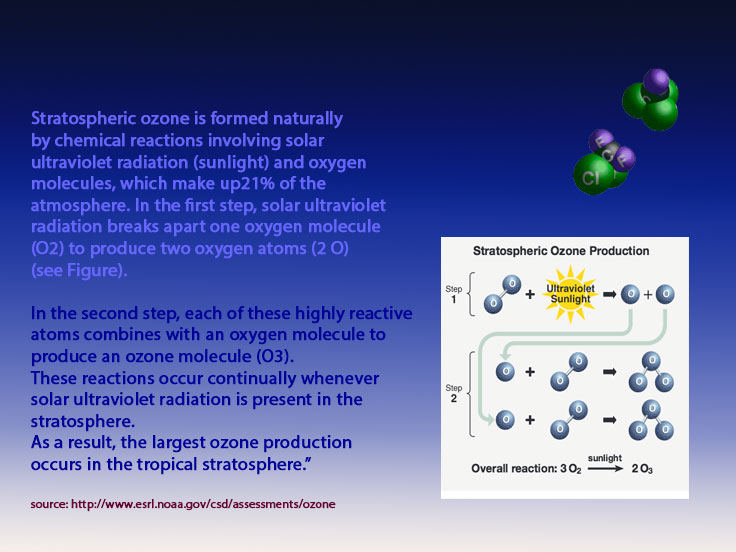
 Ozone holes at the poles due to less UV radiation?
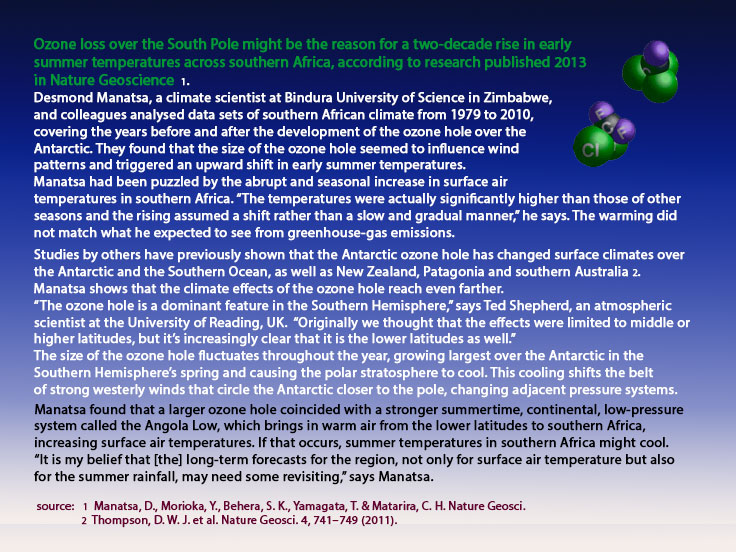
 Climate changes determined by size of Ozone hole?